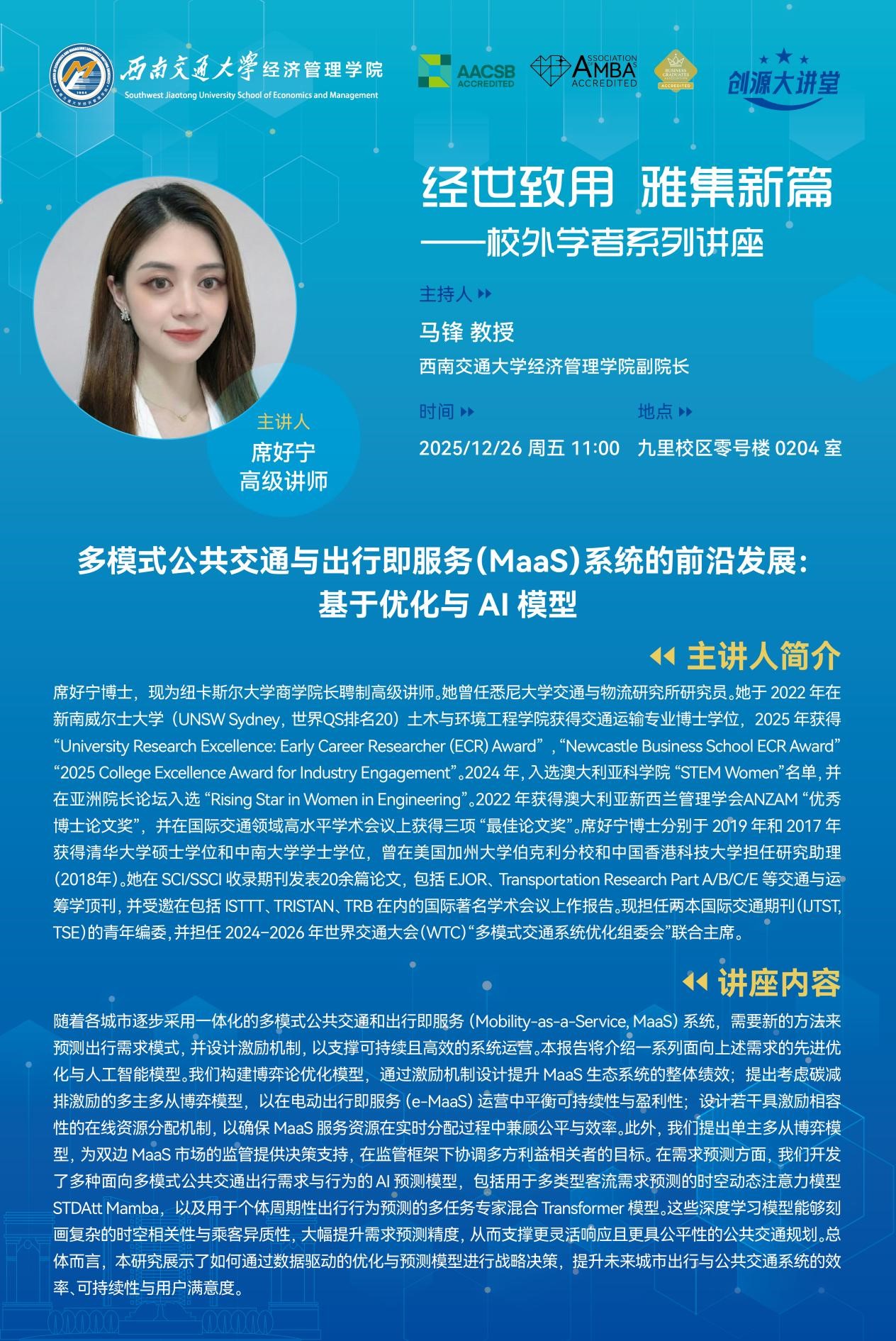
Speaker Profile
Dr. XI Haoning is a Tenured Senior Lecturer at the Newcastle University Business School. She previously served as a Research Fellow at the Institute of Transport and Logistics Studies, the University of Sydney. She completed her PhD in Transport Engineering at the School of Civil and Environmental Engineering, the University of New South Wales (UNSW Sydney, ranked 20th in the QS World University Rankings) in 2022. In 2024, she received the UNSW Research Excellence Early Career Researcher (ECR) Award, Newcastle Business School ECR Award, and 2025 College Excellence Award for Industry Engagement. She was named to the Australian Academy of Science’s STEM Women list in 2024, and selected as a Rising Star in Women in Engineering by the Asian Deans Forum.
In 2022, she won the ANZAM (Australian and New Zealand Academy of Management) Outstanding Doctoral Thesis Award, and three Best Paper Awards at high-level international academic conferences in the field of transportation. Dr. Xi obtained her Master’s degree from Tsinghua University in 2019 and Bachelor’s degree from Central South University in 2017. She worked as a Research Assistant at University of California, Berkeley, and the Hong Kong University of Science and Technology (2018).
Dr. XI has published over 20 papers in SCI/SSCI-indexed journals, including top journals in transportation and operations research such as European Journal of Operational Research (EJOR) and Transportation Research Part A,B,C,E, and has been invited to present at prestigious international academic conferences including ISTTT, TRISTAN, and TRB. She currently serves as a Young Editorial Board Member for the Urban Transport of China (IJTST TSE), and Co-Chair of the Multimodal Transport System Committee for the World Transport Convention (WTC) from 2024 to 2026.
Abstract
As cities increasingly adopt integrated multimodal public transport and Mobility-as-a-Service (MaaS) systems, it is necessary to predict travel demand patterns and design incentive mechanisms to support sustainable and efficient system operations. This presentation will introduce a series of advanced optimization and AI models tailored to these needs.
We constructed a game theory optimization model to improve the overall efficiency of the MaaS ecosystem through incentive mechanism design; proposed a multi-principal-multi-agent game model that accounts for emission reduction, to balance sustainability and profitability in electric Mobility-as-a-Service (e-MaaS) operations; and designed several incentive-compatible bilateral resource allocation mechanisms to ensure fairness and efficiency in the real-time allocation of MaaS service resources. Additionally, we developed a single-principal-multi-agent game model to support the rapid development of regulatory modules in the edge MaaS market, coordinating the goals of multiple stakeholders within the regulatory framework.
In terms of demand forecasting, we developed multiple AI prediction models for multimodal public transport travel demand and behavior, including the spatiotemporal dynamic attention model (STDAtt-Mamba) for forecasting multi-type passenger flow demand, and a multi-task mixture-of-experts Transformer model for predicting individual periodic travel behavior. These deep learning models can capture complex spatiotemporal correlations and heterogeneity, significantly improving demand forecasting accuracy, thereby supporting more responsive and equitable public transport planning.
Overall, this research demonstrates how data-driven optimization and prediction models can enable strategic decision-making to enhance the efficiency, sustainability, and user satisfaction of future urban mobility and public transport systems.
Date/Time: December 26, 2025, 11:00 a.m.
Venue: Room 0204, Teaching Building 0, Jiuliu Campus